## TL;DR
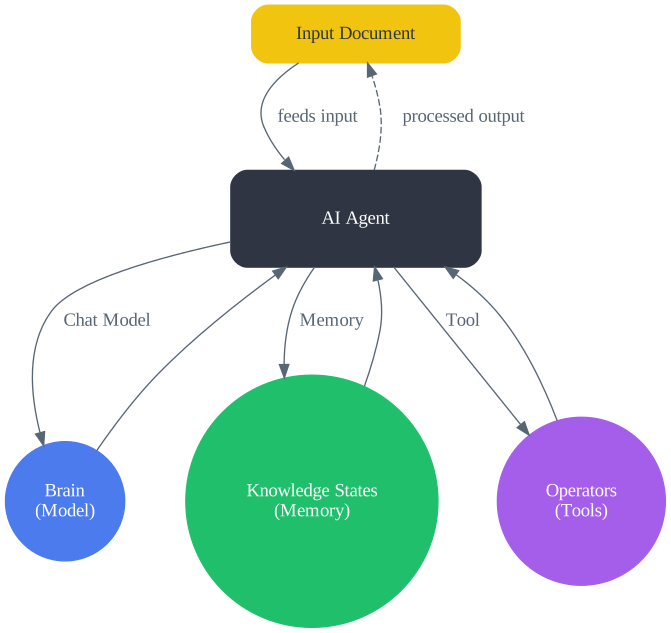
AI Agent Knowledge Evolution ≈ Knowledge States + Operators → Iterative Improvement
* Knowledge States (KS): Snapshots of what the agent currently knows
* Operators (O): Goal-directed actions that transform knowledge
* Iteration: KS₀ → O → KS₁ → O → KS₂ → … → KSₙ (richer, more actionable knowledge)
Table of Contents
Open Table of Contents
Introduction
Most people think of AI agents as chatbots or assistants, but fewer understand the foundations that power their reasoning. A big part of this comes down to two concepts: knowledge states and operators. Recently, I’ve been exploring how to actually build a system that improves its knowledge instead of degrading it over many iterations, and I thought it would be interesting to walk through the process here.
Overview Diagram
Knowledge States: Snapshots of What’s Known
Think of a knowledge state as a structured representation of what an agent currently knows about a topic. For example, if I feed my blog post about my Job Application Tracker into an LLM parser, I can turn it into a structured JSON like this:
{
  "topic": "Job Application Tracker",
  "problems": [
    "Tracking job applications manually is time-consuming",
    "Hard to analyze patterns from emails"
  ],
  "solution": {
    "tools": ["n8n", "Google Sheets", "Classification models"],
    "pipeline": "Emails → Classifier → Google Sheet"
  },
  "future_work": [
    "Expand to cover recruiter responses",
    "Visualize analytics"
  ]
}
That JSON is my knowledge state 0 (KS0). It’s the “current snapshot” of facts extracted from the article.
Operators: The Actions That Transform Knowledge
An operator is an action that takes one knowledge state and produces another. These are not just functions — they’re goal-directed transformations.
Examples of operators for my system could be:
- Summarize: compress raw text into structured claims.
- Cross-check: verify claims against source evidence.
- Refine: remove duplicates, inconsistencies, or vagueness.
- Expand: generate related questions or possible improvements.
The key point is: operators let the agent move from KS0 → KS1 → KS2 → …
Iterations: Walking Through an Example
Let’s go back to the Job Tracker article.
- Iteration 0 (raw parsing): Extract the basic JSON shown earlier.
- Iteration 1 (refinement operator): Clean it up. Maybe the “solution” is too vague - the operator adds detail:
"solution": {
  "tools": ["n8n", "Google Sheets", "Classification models"],
  "pipeline": {
    "step1": "Collect job-related emails",
    "step2": "Classify into applied/rejected/etc.",
    "step3": "Update Google Sheet automatically"
  }
}- Iteration 2 (expansion operator): Generate research questions:
"future_work": [
  "Handle recruiter responses with NLP sentiment analysis",
  "Add dashboards to track application success rate",
  "Explore privacy/security concerns in storing data"
]
Now the knowledge state has become richer and more actionable.
Why Is This Interesting
What excites me about this is that we’re no longer treating an article (or any source) as static. Instead, the agent is actively reasoning over it through operators. With each iteration, it learns more, asks sharper questions, and creates a clearer roadmap of knowledge.
From an AI safety perspective, this is particularly important. One of the challenges in AI alignment is ensuring systems don’t degrade or misinterpret knowledge over time. By structuring reasoning as knowledge states + operators, we create a framework where knowledge is traceable, verifiable, and incrementally improvable. Rather than relying on a single output from a black-box LLM, the system develops a documented chain of reasoning that can be audited, corrected, and aligned with human intent.
Unlike a one-shot LLM summary, here, the agent builds knowledge over time, much like a researcher revisiting a paper to refine their understanding.
Next Steps
I plan to implement a small-scale prototype of this system:
- Use an LLM (maybe a 13B model locally) to extract and refine JSON states.
- Define a handful of operators as Python functions.
- Run multiple iterations over the same document to see how knowledge evolves.
The long-term vision is something like: mind (AI), memory (database), and operators (actions) - all working together.